
May 16, 2026 · News
Rhodiola Rosea Benefits: Energy, Focus & Stress (Honest 2026 Guide)

What Are the Rhodiola Rosea Benefits? An Honest Look at the Evidence
If you've been researching natural ways to manage stress, boost mental energy, or push through burnout, you've likely come across rhodiola rosea benefits. This adaptogenic herb — sometimes called "Arctic root" or "golden root" — has been used in traditional medicine across Russia, Scandinavia, and China for centuries, and it now has a growing body of modern clinical research behind it. This guide cuts through the hype to explain what rhodiola actually does, what the science genuinely supports, how to dose it, and whether a tincture or capsule is the better delivery form for you.
What Is Rhodiola Rosea?
Rhodiola rosea is a flowering plant native to cold, mountainous regions of Europe and Asia — particularly Siberia, the Arctic, and high-altitude areas of Scandinavia. Adaptogens are a class of herbs that are thought to help the body resist physical and psychological stressors by modulating the hypothalamic-pituitary-adrenal (HPA) axis and sympathoadrenal system — essentially, the biological machinery behind the stress response.
What makes rhodiola particularly interesting compared to other adaptogens is its two primary active compound groups: rosavins and salidrosides. Standardized rhodiola extracts typically contain 3% rosavins and 1% salidrosides, a ratio that closely mirrors the natural composition of the root and is used as the benchmark in most clinical research.
Rosavins vs. Salidrosides: What Each Does
Rosavins are a group of phenylpropanoids specific to rhodiola rosea (they're not found in related species). They're thought to be primarily responsible for rhodiola's anti-stress and mood-supporting effects, potentially through influence on serotonin and dopamine transport. Salidrosides, on the other hand, are found in other rhodiola species and appear to drive the herb's anti-fatigue and neuroprotective properties. Together, these two compound groups are believed to create the full-spectrum adaptogenic effect that has made rhodiola a subject of active research.
What the Research Actually Shows
Let's be direct: rhodiola research is promising but not definitive. Most studies are relatively small, and large-scale randomized controlled trials are still limited. That said, the consistent direction of the evidence across multiple trial types is meaningful.
Stress and Burnout
A 2012 study published in Phytomedicine found that rhodiola rosea extract significantly reduced symptoms of burnout — including exhaustion, impaired concentration, and reduced productivity — in adults with stress-related fatigue over a 12-week period. A 2015 systematic review published in Phytomedicine examined 36 animal studies and 6 human trials and concluded that rhodiola consistently showed anti-stress and anti-fatigue effects, though the authors noted that higher-quality trials were still needed. The European Medicines Agency (EMA) has formally recognized rhodiola rosea for the relief of stress-related exhaustion and declining capacity for concentration, based on well-established medicinal use.
Mental Fatigue and Cognitive Performance
Research suggests that rhodiola may support cognitive function under stress conditions — not by acting as a stimulant, but by reducing the mental impairment that stress causes. A double-blind, placebo-controlled trial published in Phytomedicine (2000) found that students who took rhodiola before exam periods reported less mental fatigue and improved capacity for complex cognitive tasks. Another study with night-shift physicians found improvements in error rate and cognitive speed with rhodiola supplementation. These are modest but consistent findings.
Physical Performance and Fatigue
Some evidence suggests rhodiola may reduce perceived exertion and improve endurance performance, though results here are more mixed. A 2004 trial in the International Journal of Sport Nutrition and Exercise Metabolism found improved time-to-exhaustion in trained athletes. More recent meta-analyses have been cautiously optimistic but emphasize that effect sizes are generally small.
Mood and Mild Depression
A pilot study published in the Nordic Journal of Psychiatry found that a standardized rhodiola extract may support improvements in mild-to-moderate depression symptoms compared to placebo. Research suggests this may involve serotonin and dopamine pathways, but the mechanism isn't fully understood. Importantly, rhodiola should not replace clinical treatment for depression — it may support mood under stress, but it is not a treatment for clinical mood disorders.
Typical Dosage: How Much Rhodiola Should You Take?
Most clinical studies use doses in the range of 200–600mg per day of a standardized extract (3% rosavins, 1% salidrosides). Many practitioners suggest starting at the lower end (200–300mg) and assessing your response before increasing. Some protocols use "cycling" — taking rhodiola for several weeks, then pausing — though there's no strong clinical evidence that cycling is necessary. Rhodiola is generally taken in the morning or early afternoon, as some users report that evening use can interfere with sleep due to its mild energizing properties.
Consistent use over several weeks appears to be important for full effect. Short-term acute use (e.g., a single dose before an exam) may provide some benefit, but the adaptogenic benefits tend to build with sustained use.
Rhodiola Tincture vs. Capsule: Which Is Better?
Both forms deliver the same active compounds, but there are meaningful differences in how quickly they're absorbed and how easy they are to dose.
Tincture Advantages
Liquid tinctures are absorbed sublingually (under the tongue) and through the mucosal lining of the mouth, which means active compounds can enter the bloodstream faster than a capsule that must dissolve in the stomach. This can translate to a quicker onset, which may be useful if you're taking rhodiola situationally — before a stressful presentation, a hard training session, or a demanding workday. Tinctures also allow flexible dosing: you can precisely adjust by number of drops, making it easy to start low and titrate up.
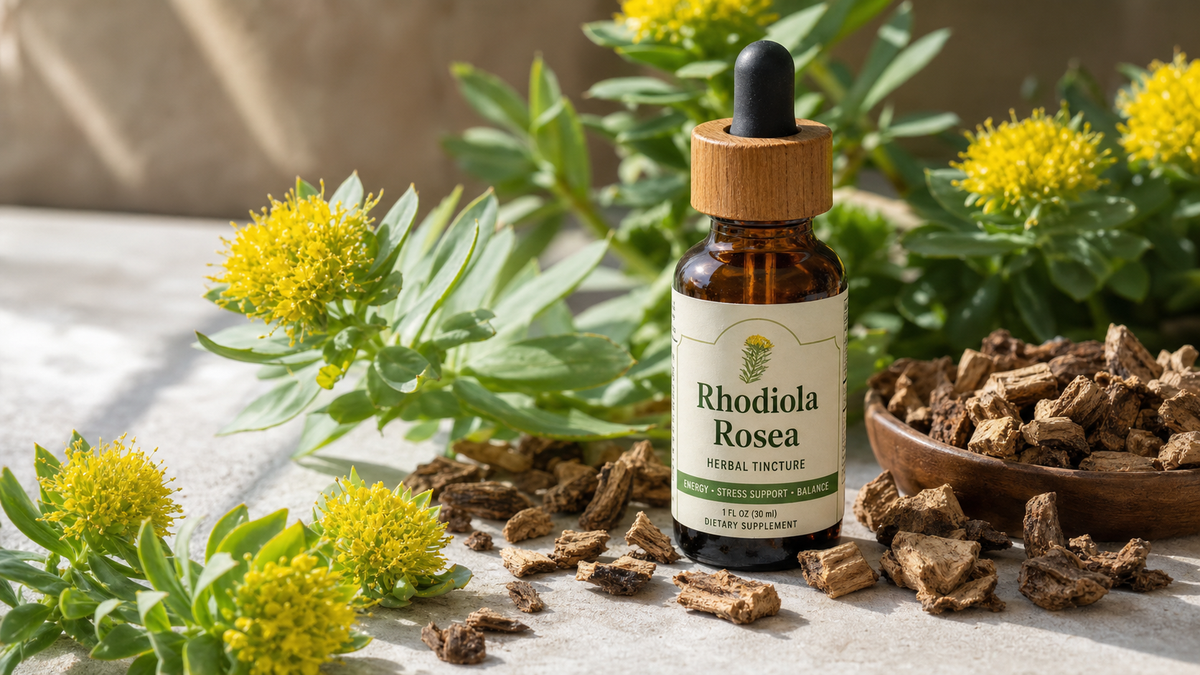
The Rhodiola Rosea Tincture at Workoutyes delivers a concentrated, fast-absorbing liquid form that's particularly well-suited for people who want flexibility and fast onset. It's a 2 oz bottle designed for daily use or situational support.
Capsule Advantages
Capsules are more convenient for travel, easier to dose consistently, and tend to have less of a taste profile than tinctures (rhodiola has a notable earthy, slightly bitter flavor). If convenience and taste are priorities, capsules are a reasonable choice. The key is to confirm that the capsule uses a standardized extract at the 3:1 rosavin-to-salidroside ratio for research-backed potency.
Who Is Rhodiola For — and Who Should Be Cautious
Rhodiola may be a good fit for adults experiencing stress-related fatigue, mental burnout, or sluggish cognitive performance under pressure. It's popular among students, professionals, and athletes looking for a non-stimulant performance edge.
However, it's worth noting some cautions:
- Bipolar disorder: Rhodiola's mild stimulating or mood-modulating effects may not be appropriate. Consult a psychiatrist first.
- Autoimmune conditions: As an adaptogen that modulates immune response, caution is warranted if you have an autoimmune disease.
- Pregnancy and breastfeeding: Insufficient safety data exists; avoid supplementation without medical guidance.
- Medications: Rhodiola may interact with antidepressants (particularly SSRIs and MAOIs) and stimulant medications. Talk to your doctor if you're on prescription medication.
- Anxiety: Some users report an increase in anxiety at higher doses, particularly those sensitive to stimulants. Start low.
The Rhodiola Rosea Tincture is available in our HSA & FSA Eligible Collection and may qualify for pre-tax reimbursement through TrueMed at checkout. If you're looking to pair rhodiola with broader nutritional support, the Daily Liquid Multivitamin + Minerals is a practical complement — ensuring that baseline deficiencies in B vitamins, iron, and trace minerals aren't contributing to the fatigue you're trying to address. And for immune and cognitive support from a different angle, the Organic Mushroom Complex stacks well with adaptogens like rhodiola.
Frequently Asked Questions
How long before I notice the effects of rhodiola?
Some people notice a mild improvement in mental clarity and energy within the first week. The anti-stress and anti-fatigue effects, however, tend to build over two to four weeks of consistent use. Set realistic expectations — rhodiola works subtly and systemically, not like a cup of coffee.
Can I take rhodiola every day?
Yes, daily use is how most clinical studies are structured and is generally considered safe for healthy adults. Some practitioners recommend a two-week break every three months, though this cycling approach is more traditional than evidence-based. Listen to your body and check with your doctor if you plan to use it long-term.
Is rhodiola rosea safe to combine with caffeine?
Rhodiola and caffeine are commonly combined (as seen in many pre-workout and nootropic stacks), and there are no known dangerous interactions. That said, if you're sensitive to stimulants or prone to anxiety, be cautious adding rhodiola to an already-caffeine-heavy routine. The two have different mechanisms — rhodiola reduces stress biology while caffeine blocks adenosine — so the combination tends to feel smoother than high-dose caffeine alone.
What's the difference between rhodiola rosea and other rhodiola species?
Rhodiola rosea is the most studied species and the only one that contains rosavins in significant amounts. Other species like Rhodiola crenulata and Rhodiola imbricata contain salidrosides but not the same rosavin profile. When purchasing, confirm the extract is from Rhodiola rosea specifically and is standardized to 3% rosavins / 1% salidrosides to ensure you're getting the form used in clinical research.
HSA & FSA: Pay With Pre-Tax Dollars
Many supplements and wellness devices qualify for HSA or FSA reimbursement with a Letter of Medical Necessity (LMN). At Workoutyes, we partner with TrueMed — at checkout, you can answer a quick health questionnaire and, if you qualify, get an LMN issued instantly. You then use your HSA/FSA card or get reimbursed by your administrator.
Browse our HSA & FSA Eligible Collection to see every product that qualifies. Rhodiola Rosea Tincture is one of our most-loved picks in this category.
This article is for educational purposes only and is not medical advice. Always talk to your doctor before starting a new supplement or device, especially if you take medication or have a health condition. Individual results vary.