
May 16, 2026 · News
Collagen Protein vs Whey: Which One Should You Take?
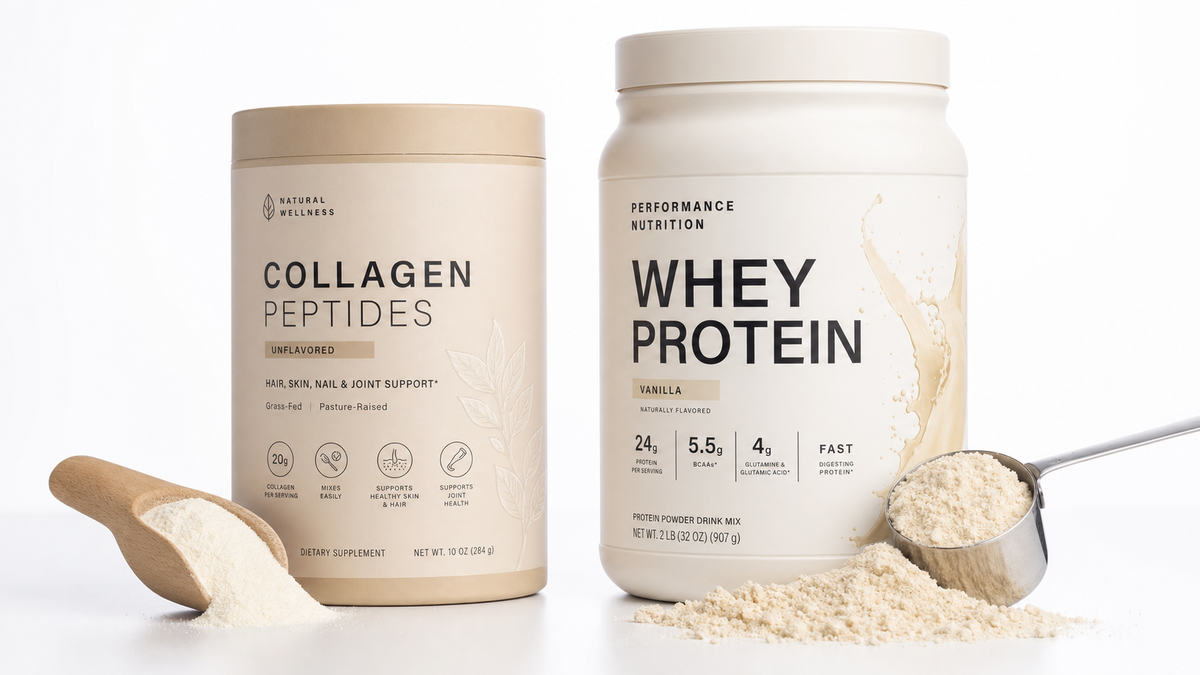

When it comes to protein supplements, the debate over collagen vs whey often gets reduced to "which one builds more muscle?" But that framing misses the point. Whey and collagen do very different things in the body — and understanding those differences will help you decide whether to choose one, the other, or both. Here's the honest breakdown.
The Amino Acid Profiles: Why They're Not the Same Protein
Protein is made of amino acids, but not all proteins contain the same amino acids in the same ratios. This is the core reason whey and collagen have such different applications.
Whey Protein: A Complete Protein
Whey is derived from milk during cheese production. It's a complete protein — meaning it contains all nine essential amino acids (the ones your body can't synthesize and must get from food). Whey is particularly high in leucine, the branched-chain amino acid (BCAA) that acts as the primary trigger for muscle protein synthesis (MPS). It also scores near-perfect on the DIAAS (Digestible Indispensable Amino Acid Score), the most current measure of protein quality.
This makes whey protein the gold standard for supporting muscle repair and growth, especially in the post-workout window when MPS signaling is most receptive.
Collagen Protein: Rich in Structural Amino Acids
Collagen is the most abundant protein in the human body — it forms the structural matrix of skin, tendons, ligaments, cartilage, and bone. Collagen protein supplements are derived from animal connective tissue (typically bovine hide, fish skin, or chicken) and hydrolyzed into smaller peptides for absorption.
The amino acid profile of collagen is radically different from whey. Collagen is exceptionally high in glycine, proline, and hydroxyproline — three amino acids that are rare in most dietary proteins. Hydroxyproline in particular is essentially unique to collagen and is critical for cross-linking collagen fibers in connective tissue. However, collagen is not a complete protein — it lacks sufficient tryptophan — and it has a much lower leucine content than whey.
This means collagen is not an effective driver of muscle protein synthesis, but it provides raw materials that most diets are low in for connective tissue repair and maintenance.
Types of Collagen: I, II, III and What They Do
Not all collagen is the same. There are at least 28 types identified in the human body, but three dominate in supplements:
- Type I: The most abundant type. Found in skin, tendons, bone, and most connective tissues. This is what most bovine and marine collagen supplements provide. Best evidence for skin elasticity and joint support.
- Type II: Found specifically in cartilage. Undenatured type II collagen (UC-II) has its own distinct mechanism — research suggests it may work through oral tolerance to reduce cartilage degradation in joints, particularly the knees. Typically derived from chicken sternum cartilage.
- Type III: Found alongside type I in skin and blood vessels. Often present in bovine collagen supplements and may support skin health and vascular integrity.
For skin and joint support, type I (and III) collagen peptides are the most studied. For knee-specific cartilage concerns, undenatured type II has a distinct and separate evidence base. Our Collagen Protein provides hydrolyzed collagen peptides in an easy-mixing powder form — one of the most convenient ways to consistently hit the studied daily dose.
Use Cases: Matching the Protein to the Goal
Muscle Protein Synthesis → Whey Wins
If your primary goal is building or preserving lean muscle — whether you're an athlete, in a calorie deficit, or an older adult trying to offset age-related muscle loss (sarcopenia) — whey protein has the clearest evidence. The leucine threshold for triggering MPS is well-established, and whey crosses it reliably. A typical dose of 20–40g post-workout provides approximately 2–3g of leucine, which is sufficient to maximally stimulate MPS in most adults.
Collagen does not meaningfully stimulate MPS on its own. Studies that have compared collagen to whey for muscle gain consistently show whey producing significantly greater outcomes.
Skin, Joints, and Tendons → Collagen's Territory
The evidence for collagen supplementation has become substantially stronger in the past decade. A 2019 meta-analysis in the Journal of Drugs in Dermatology found that hydrolyzed collagen supplementation significantly improved skin elasticity and hydration compared to placebo across multiple studies. A 2021 review in the British Journal of Sports Medicine found evidence supporting collagen peptide supplementation for reducing joint pain and improving function in athletes.
The proposed mechanism: hydrolyzed collagen peptides are absorbed into the bloodstream and accumulate in cartilage and skin tissue, where they stimulate local cells (chondrocytes and fibroblasts) to produce more collagen. Vitamin C is needed for this process — taking collagen with a vitamin C source may improve outcomes, which is why many collagen supplements include it.
For tendon health specifically, a 2017 study in the American Journal of Clinical Nutrition found that 15g of hydrolyzed collagen taken with 50mg of vitamin C before exercise improved collagen synthesis markers and may support recovery from tendon injuries. Our Iron Feather Collagen is a premium option that pairs clean collagen peptides with complementary ingredients — well-suited for those focused on joint and connective tissue support.
Gut Health
Glycine — one of collagen's primary amino acids — is associated with intestinal barrier support. While the research is still emerging, some practitioners recommend collagen peptides as part of a gut-health protocol, given glycine's role in mucin synthesis and tight junction integrity. This is a secondary benefit that whey protein doesn't share to the same extent.
Dosage: How Much Do You Need?
The most commonly studied dosages in clinical trials are:
- Collagen for skin: 2.5–10g per day, with most significant effects at the 10g level in studies
- Collagen for joints: 10–15g per day (some studies on UC-II use much lower doses, 40mg/day, due to its different oral tolerance mechanism)
- Whey for muscle: 20–40g per serving, timed around resistance exercise
The practical takeaway: 10–20g of collagen daily is a reasonable target for connective tissue and skin goals. This can easily be added to coffee, smoothies, or oatmeal since most hydrolyzed collagen powders are tasteless and dissolve completely.
Can You Stack Whey and Collagen?
Yes — and for many people, this is actually the optimal strategy. They don't compete; they complement. Take whey protein post-workout to drive muscle protein synthesis. Add collagen daily (morning coffee or pre-workout with vitamin C) to support connective tissue health and skin. The amino acids they provide are largely non-overlapping, so they address different physiological needs simultaneously.
This is particularly relevant for athletes who put stress on both muscle and connective tissue — tendons and ligaments adapt more slowly to training than muscles do, which is one reason overuse injuries are common in people who train hard. Consistent collagen intake may help close that gap.
If budget is a constraint and you have to choose one, default to whey if muscle is your primary goal, or collagen if skin and joint health are the priority. If you're over 40, the case for collagen gets stronger as endogenous collagen production naturally declines with age.
Frequently Asked Questions
Is collagen protein good for weight loss?
Collagen protein may support satiety — some research suggests it's more filling per gram than other protein sources, potentially due to its specific amino acid ratios. However, it shouldn't replace a balanced protein strategy. For body composition, total daily protein intake matters most. Collagen is a useful supplement to that total, not a replacement for complete proteins.
Does collagen actually improve skin?
The evidence is more solid than many expect. Multiple double-blind, placebo-controlled trials have shown improvements in skin elasticity, hydration, and wrinkle depth with 2.5–10g daily hydrolyzed collagen over 8–12 weeks. The effect size varies, but the signal is real. Results are typically most visible in people over 35, where endogenous collagen production has already begun to decline.
Which collagen is best — bovine, marine, or chicken?
For skin and joint benefits (types I and III), bovine and marine collagen are both well-studied and effective. Marine collagen has a slightly smaller peptide size and may absorb marginally faster. Bovine collagen is more cost-effective and widely available. For cartilage-specific support, chicken-derived undenatured type II collagen (UC-II) has its own distinct mechanism and evidence base. The Collagen Protein and Iron Feather Collagen at Workoutyes both offer high-quality hydrolyzed options.
Can I take collagen without doing resistance training?
Yes. Collagen's primary benefits — skin, joint, tendon, and gut support — don't require resistance training. The exercise connection is primarily relevant for tendon collagen synthesis (the 2017 study mentioned above showed exercise timing mattered). But for skin and general joint health, consistent daily intake regardless of workout schedule appears sufficient based on current evidence.
HSA & FSA: Pay With Pre-Tax Dollars
Many supplements and wellness devices qualify for HSA or FSA reimbursement with a Letter of Medical Necessity (LMN). At Workoutyes, we partner with TrueMed — at checkout, you can answer a quick health questionnaire and, if you qualify, get an LMN issued instantly. You then use your HSA/FSA card or get reimbursed by your administrator.
Browse our HSA & FSA Eligible Collection to see every product that qualifies. Collagen Protein is one of our most-loved picks in this category.
This article is for educational purposes only and is not medical advice. Always talk to your doctor before starting a new supplement or device, especially if you take medication or have a health condition. Individual results vary.